
 Contact

Community
The Cornerstone of Digital Trust: The Strategic Value and Execution Principles of IT General Controls (ITGC)
- Date2026.07.06
Today, companies are in a position where they must digitally transform all their business processes. Consequently, data integrity and system stability are directly tied to a company's survival. In this regard, as efforts to secure the reliability of financial statements and strengthen corporate governance continue, the importance of IT General Controls (ITGC), which are applied across the entire IT system, is being emphasized more than ever. Today, we will explore the concept and core areas of ITGC, which serves as the foundation for elevating corporate digital trust.
The Definition and Role of ITGC in Guaranteeing IT Operational Stability
ITGC refers to the policies and procedures applied to the entire information technology environment, enabling application controls to operate effectively at a higher level. Rather than being limited to a specific business process, its goal is to establish a comprehensive management framework that encompasses the entire IT infrastructure, including system development, program changes, data center operations, and information security. An organization without proper ITGC established will find it difficult to protect its data from external intrusions, artificial manipulation, or operational mistakes, no matter how excellent its software performance may be. Therefore, through ITGC, companies can secure the basis for decision-making grounded in the reliability of information systems and the accuracy of data.
Risk Management Through Access Management and Program Change Management
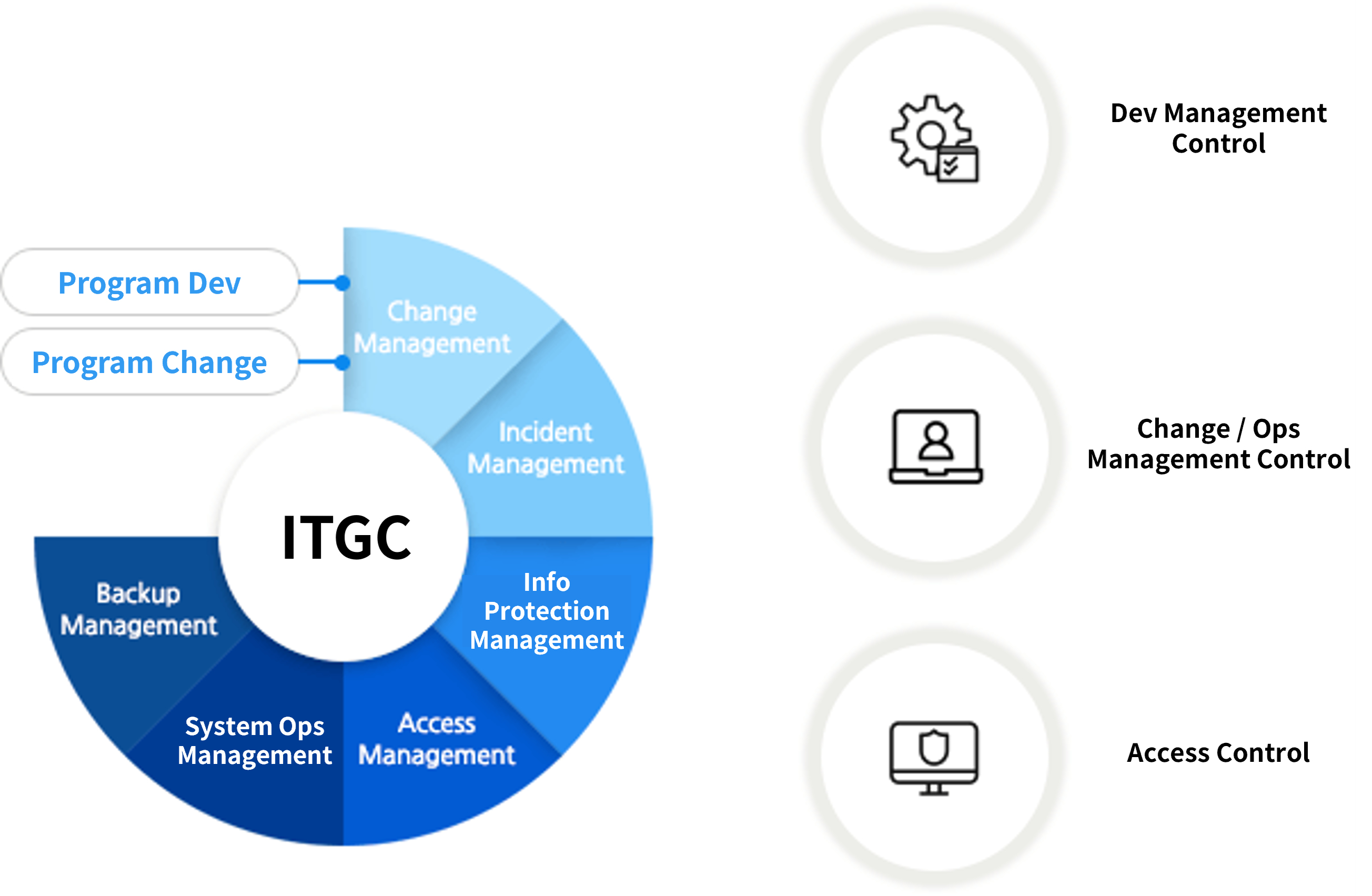
The core areas of ITGC are logical access management and program development and change management. Access management strictly controls systems so that only qualified users can access data according to their authority and perform only permitted functions. It systematizes the procedures for granting and revoking permissions according to the user's lifecycle, from onboarding to offboarding. Through this, the possibility of abnormal data access or manipulation can be fundamentally blocked.
The program change management process ensures that a thorough testing and approval procedure is undergone whenever modifications occur in the operating system. It can prevent unexpected system errors or intentional code modifications. This process strictly separates the development environment from the operational environment, manages the source code history, and ultimately guarantees system continuity.
Through these two management processes, companies can equip themselves with the framework and capabilities to safely protect their business assets from complex IT risks.
Audit and Regulatory Compliance for Building Transparent Governance
In today's business environment, companies must comply not only with strengthened external audit laws but also with robust global regulations like the Sarbanes-Oxley Act (SOX). In this environment, ITGC serves as a key inspection target for external auditors and an objective measure to prove corporate transparency. Auditors closely examine the design adequacy and operational effectiveness of ITGC. To do this, they verify whether the IT infrastructure environment—where the company's financial data is generated and stored—is sufficiently controlled.
Deficiencies discovered within ITGC impact the reliability of all information produced by the respective system and the financial statements as a whole. Therefore, through regular internal audits and evidence management, companies must always be able to prove that their ITGC is being executed according to regulations. This demonstrates to the market and stakeholders just how robust and transparent the company's operating system is.
ITGC: Delivering Value Beyond Regulatory Compliance
Systematized system operation standards and data center management procedures enable rapid service recovery even in the event of large-scale failures or disasters. Furthermore, standardized control procedures increase the efficiency of IT operations and minimize cost losses caused by human error. The successful establishment of ITGC drastically improves the operational stability of the entire organization, realizing value that goes far beyond mere regulatory compliance.
Ultimately, ITGC must be recognized not solely as a task for the IT department, but as a company-wide risk management strategy that guarantees business sustainability. Only then can organizations stably embrace new technological innovations in a rapidly changing digital environment. The successful establishment of ITGC will serve as the key to repeatedly achieving growth while unwaveringly maintaining digital trust in the face of any cri