
 Contact

Community
Financial Sector IT Governance (ITG) Implementation Case Study
- AuthorAdministrator
- Date2016.10.27
Financial Sector IT Governance (ITG) Implementation Case Study
ITG Defined
ITG (IT Governance), defined in various forms across different organizations, is ultimately a decision-making framework composed of principles, organizational structures, and process information for the systematic utilization and management of IT resources aligned with enterprise business objectives.
ITIL, which focuses on meeting business requirements, reducing costs, and improving IT service quality through IT-business alignment, stands out as one of the best approaches for building ITG frameworks because it is non-proprietary, non-prescriptive, and based on common and best practices.
ITIL and ITG
Typically, ITG aims for:
- Alignment of IT and business
- Business value creation through IT
- Efficient utilization of IT resources
- Risk management through continuous monitoring of IT operations
This raises ongoing questions such as:
What, Where, Who, When, How, and based on which criteria should decisions be made?
The biggest challenge organizations face when pursuing ITG is determining its scope and deciding how to implement an actual ITG system.
In this regard, an ITSM system based on ITIL can be an excellent alternative for organizations starting ITG or seeking to advance it.
ITIL fundamentally focuses on the service lifecycle, which is process-centric.
The strength of this lifecycle lies in continuous feedback across all stages.
Each element provides control points for feedback, ensuring service optimization is managed and measured from a business perspective at any point in time.
Each part influences others and receives input from them, enabling checks and balances across the lifecycle.
This means that when the business requests changes, services can be modified to respond effectively.
The core principle of the service lifecycle is:
“Services deliver measurable value aligned with business objectives and outcomes.”
This aligns perfectly with ITG’s purpose.
Building ITG Systems Based on ITIL
As described above, let’s examine the approach to building ITG frameworks using ITSM systems based on ITIL through the case of Company S.
Company S successfully implemented its ITG core system quickly and efficiently using STEG’s E-GENE™ ITSM solution.
As shown in the ITG System Functional Structure, Company S’s ITG system was defined and implemented with three functional areas:
- User Channel Area
- Core Business Processing Area
- Reference Information Area
- Including integration with external systems.
Ultimately, the system aimed to:
- Collect EA (Enterprise Architecture) and asset information, including AA, BA, DA, and TA
- Synchronize with source systems for real-time updates
- Enable linkage across functional areas for End-to-End management and monitoring
● Company S ITG System Functional Structure
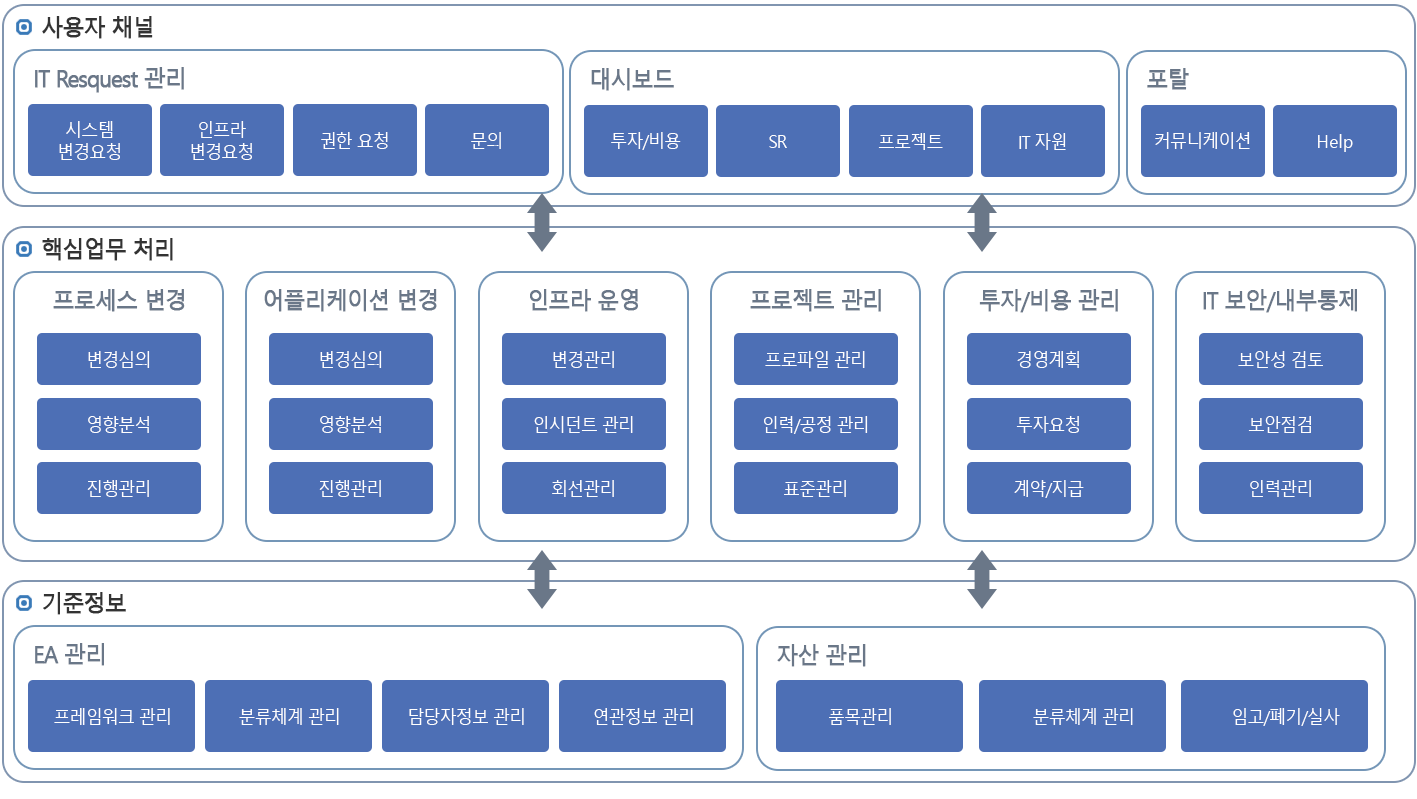
The system covered most of the Evaluation, Implementation, Operation, and Monitoring process areas defined in ITG, including IT investment domains, using STEG’s E-GENE™ ITSM solution.
Through seamless integration between processes and core functional modules, the system achieved End-to-End integrated monitoring, fulfilling ITG’s requirement for continuous monitoring of IT operations for risk management and enabling effective delivery of IT service value to customers.
● End-to-End Systemic Management Framework Implementation

ITG Implementation Approach Based on Company S Case
High-performing service organizations understand how to deliver value to customers and systematically apply service management practices defined from the customer’s perspective.
They ensure customers can focus solely on their business without worrying about IT service reliability.
Such trust-based partnerships are common among top-performing service providers, most of whom leverage ITIL service management practices.
In conclusion, implementing ITG frameworks based on ITIL-driven ITSM is the most efficient way to utilize existing IT assets—defined in ITIL as IT resources and capabilities.
● ITSM (ITIL)-Based ITG Implementation– Min Chang-seon, Senior Manager, Solution Service Division –