
 Contact

Community
ITSM Solution: “Customer-Customized Service”
- Date2019.07.16
ITSM Solution: “Customer-Customized Service”
A beginning is an unforgettable moment for everyone. But just as easily, that moment can fade away.
I wanted to share my impressions after completing my first ITSM project with fellow beginners who are encountering ITSM for the first time.
My First Encounter with ITSM
Anyone working in the IT industry will come across ITSM (IT Service Management) at least once. I, currently employed at STEG, first encountered the E-GENE ITSM Solution during a financial project with Company K.
In the project, we implemented ITSM based on ITIL (IT Infrastructure Library) V3, focusing primarily on the Incident Management and Problem Management processes, which I will explain here.
Understanding Incident & Problem Management Processes
What are these processes?
From ITIL V3’s standard perspective:
- Incident: An unexpected event that affects IT operational services.
- Problem: An event caused by a simple incident but whose root cause cannot be identified.
In short:
- If you know the solution → It’s an Incident.
- If you need to find the solution → It’s a Problem.
Three Core Strategies for Advanced Incident & Problem Management
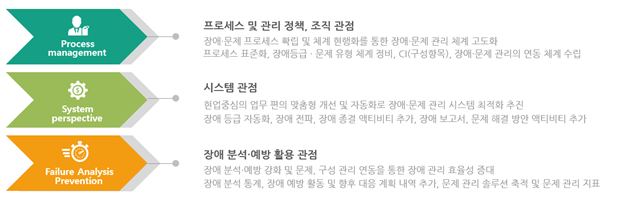
Customer-Centric Implementation
During the financial project with Company K, their requirements included:
- Collaboration-focused customized improvements and incident analysis
- Enhanced incident prevention features
- Increased efficiency through integration of problem and configuration management
To meet these needs, I implemented the following key functions in the Incident & Problem Management process:
- Standardization of processes
- Automated incident classification
- Incident propagation
- SR registration linked to other systems
- Logic-based calculation of resolution time
- Work assignment for incident/problem handling
- Advanced incident reporting features
- Integrated processing between incident and problem management
While these may seem like basic ITSM features, they differ significantly from traditional processes. Let’s break it down:
Incident Management Process
The process consists of four main stages:
Incident Registration → Incident Receipt & Propagation → Incident Resolution → Incident Closure
<1. Incident Registration>
When a customer reports an incident, SRs are automatically assigned to responsible CI (Configuration Item) handlers based on predefined business systems.
<2. Incident Receipt & Propagation>
This was the most distinctive part compared to other processes.
Company K expanded the scope of incidents beyond “service outages” to include “application errors causing service disruption.”
I implemented:
Automated calculation of incident severity based on urgency and impact
Automatic assignment of impact level based on the selected application
Real-time sharing of incident details with customers by setting propagation groups (responsible staff, team leaders, department heads) and enabling user additions/removals
<3. Incident Resolution>
The focus was on quickly identifying root causes and resolving incidents. Three major improvements were introduced:
Independent handling of Incident and Change Management: Previously linked processes caused delays. I created a structure allowing independent closure while maintaining linkage.
User-friendly SLA time display: Instead of showing resolution time only in minutes (e.g., 1880 minutes), the UI displayed days, hours, and minutes (e.g., 1 day 7 hours 20 minutes), improving customer satisfaction.
Tiered handling: If the first-level handler fails, tasks are automatically assigned to second-level handlers.
<4. Incident Closure>
I focused on meeting customer needs and reducing unnecessary work:
Incident reports included all details from registration to closure, with time charts for actions taken.
Integrated fields for future plans and prevention measures, linked to other systems for continuous improvement.
Enabled report printing to eliminate redundant documentation.
Problem Management Process
This process consists of five stages:
Problem Registration → Solution Identification → Solution Execution → Result Verification → Problem Closure
According to ITIL V3, incident and problem management should be integrated. Unresolved incidents transition to problem management, and resolved issues are registered in the KMDB (Knowledge Management Database) for future reference.
Key Success Factor
ITIL is a framework, not a customer-specific solution.
Min Chang-sun, Senior Manager of STEG’s Solution Service Division, stated:
“ITIL is a framework to be adapted, not strictly followed. Implementing ITSM based on ITIL V3 requires an integrated process approach tailored to each organization’s situation, supported by a flexible ITSM solution that can make this a reality.”
In practice, I leveraged STEG’s proprietary Workflow Engine in the E-GENE solution suite and aligned it with customer needs to deliver customized processes.
In Conclusion
Every company has its own ITSM. At my company, we are upgrading to E-GENE 5.2 and building E-GENE™ Lightning, an ITSM solution optimized for the SMB market. It’s an Out-of-the-Box solution that users can easily configure.
STEG’s motto, “The Living Evolution Gene of Service Technology,” reflects our commitment to providing robust solutions that enhance corporate competitiveness. Inspired by this first experience, I am determined to keep researching and innovating to deliver exceptional services to clients.
– Lee So-young, Solution Development Team, R&D Division –