
 Contact

Community
Understanding ITIL V4 Basic Concepts and Comparison with ITIL V3 (#1)
- Date2020.04.29
Understanding ITIL V4 Basic Concepts and Comparison with ITIL V3 (#1)
The ITIL framework, one of the best management frameworks in the IT service management domain, has been newly upgraded and released as ITIL V4. After the release of ITIL V3 in 2007, ITIL V4 was partially launched in 2019, 12 years later, and is planned to be continuously expanded and released until 2020. Therefore, this article aims to provide a brief introduction to ITIL V4 and summarize its differences from ITIL V3 in terms of Framework, Process/Practices, Lifecycle/SVS (Value System), Continual Improvement, Guiding Principles, and Four Dimension Model. Considering the volume of content, the introduction will be divided into two articles.
Detailed content on ITIL V4 will be introduced sequentially later.
1. Overview of ITIL V4
1) Concept:
ITIL V4 is an upgraded version of the ITIL V3 framework and includes improved strategic elements that better combine IT service management with business requirements. It provides an end-to-end operating model for creating, delivering, and continuously improving services, helping to build effective IT service management processes. It also offers guidance for integrating with other frameworks and methodologies such as ITIL DevOps, Lean, and Agile. Furthermore, ITIL V4 seeks to advance existing ITSM practices in the context of customer experience, value streams, and digital innovation, based on decades of ITIL evolution. One of the biggest conceptual changes in ITIL V4 compared to previous versions is its focus on co-creating value with businesses rather than simply delivering value. This includes a major shift from the traditional Service Lifecycle to the Service Value System.
2) Core Components:
The ITIL V4 framework consists of two main elements: the Service Value System (SVS) and the Four Dimensions Model, which include several key components as shown below:
2.1) Service Value System (SVS)
- Guiding Principles
- Governance Framework
- Service Value Chain
- Continual Improvement
- Management Practices
2.2) Four Dimensions Model
- Organizations and People
- Information and Technology
- Partners and Suppliers
- Value Streams and Processes
A brief introduction to these components will be provided in this article, with detailed coverage in future discussions. To understand ITIL V4’s structure, let’s first define the ITIL V3 framework briefly.
■ ITIL V3 Framework
1) Concept:
ITIL V3 is the third version of the ITIL framework, providing a globally recognized collection of best practices for IT management. It laid the foundation for evolving to better fit business environments and served as the basis for ITIL 4, which meets modern trends such as DevOps, Lean, and Agile, as well as customer and IT organizational needs.
2) Core Components:
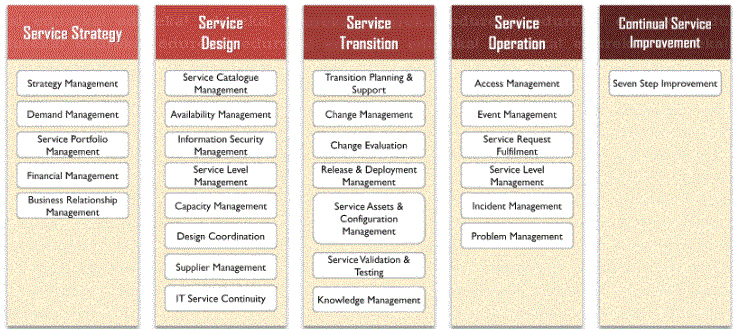
The ITIL V3 framework consists of 26 processes within 5 Service Lifecycle stages. Detailed introductions to these processes are widely available in existing materials and books.
2. ITIL V3 Processes vs ITIL V4 Practices
1) Basic Explanation:
The 26 processes emphasized in ITIL V3’s service lifecycle approach have been replaced in ITIL V4 by 34 practices aligned with trends for delivering services and value to customers. While terminology has changed and there is a stronger focus on business value, many concepts from ITIL V3 remain and have not been discarded.
The 34 practices described in ITIL V4 provide what is necessary to co-create value with customers and stakeholders. These practices significantly expand the perspective offered by ITIL V3 processes and acknowledge that every organization is different, recommending approaches tailored to specific business needs.
2) Comparison of 26 Processes & 34 Practices:
- The comparison between processes and practices is as follows, and detailed guides for ITIL V4’s new practices will be released gradually.
- Below are the elements of the 26 processes and 34 practices.
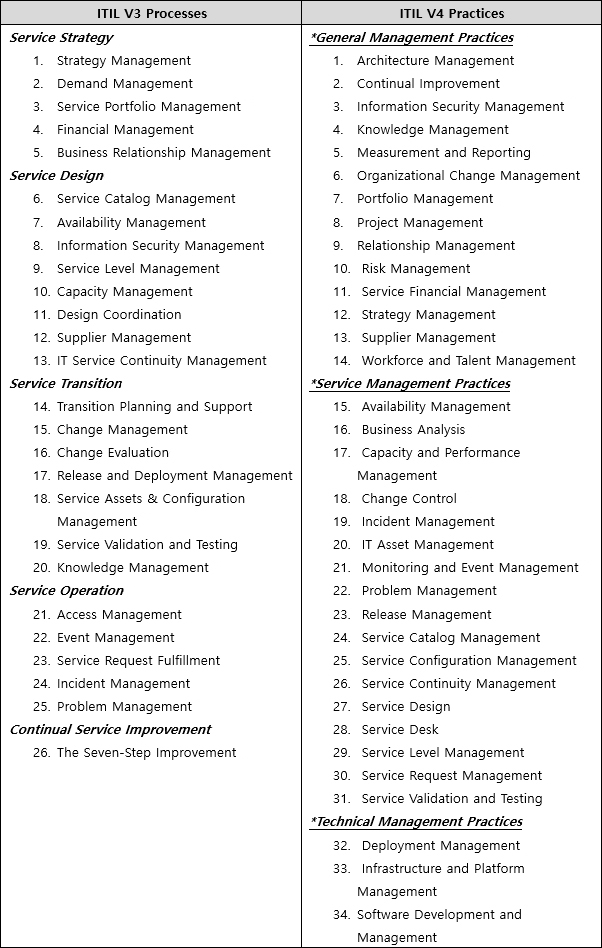
As summarized above, ITIL V4’s departure from a purely process-based approach represents a fundamental change, but many ITIL V4 practices still align with ITIL V3 processes.
3. ITIL V3 Service Lifecycle vs ITIL V4 Service Value System (SVS)
- ITIL V3 focuses on the lifecycle of IT services, emphasizing integration across domains and continual service improvement. In contrast, ITIL V4 operates based on the Service Value System, which emphasizes value. The SVS supports various approaches, from traditional process and project management methods (Waterfall) to modern methodologies such as Agile, DevOps, and Lean. In other words, ITIL SVS explains how all components and activities of an organization work together as a system to enable value creation.
Below is a summary of SVS components and a comparison with ITIL V3’s Service Lifecycle.
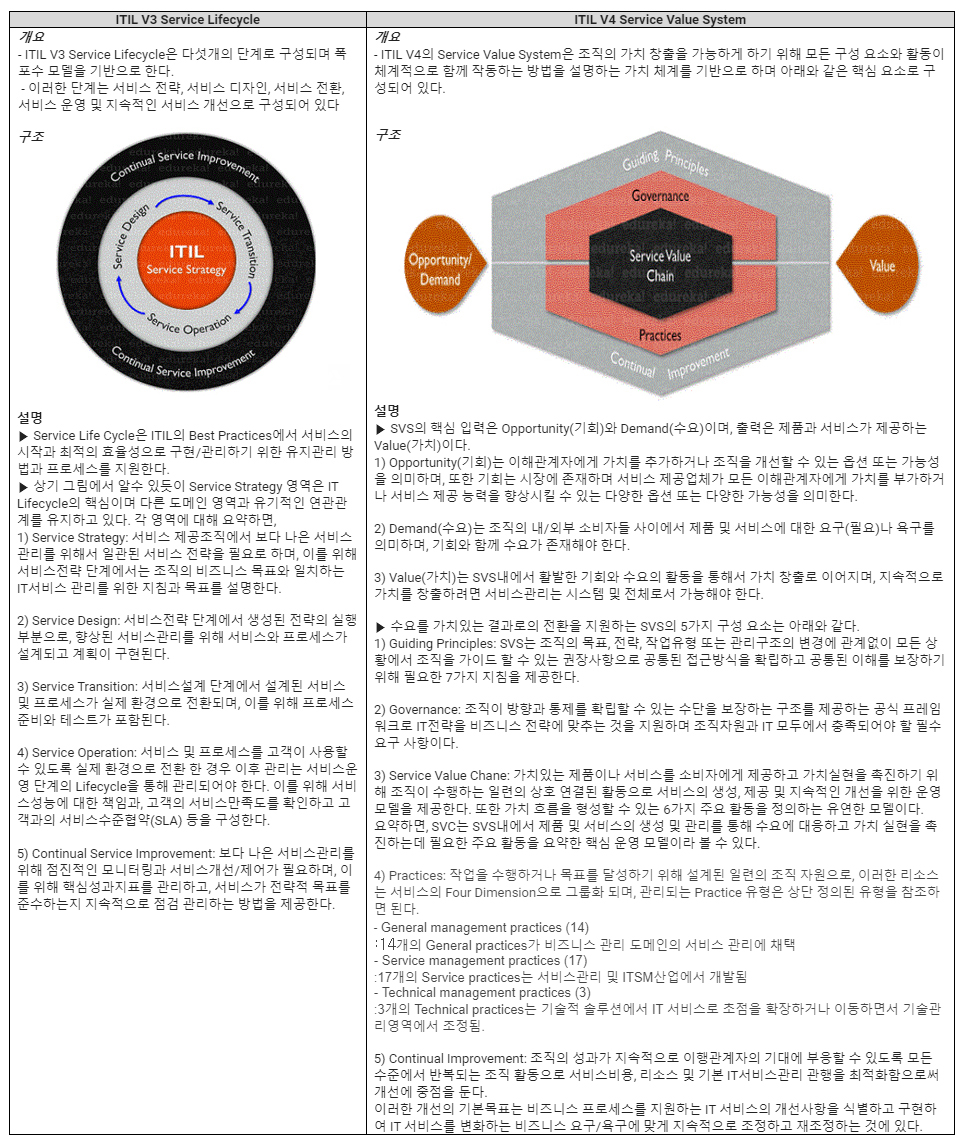
The SVS (Service Value System) is not limited by department, company, multinational organization, or organizational size. To achieve overall value and minimize negative impacts, it is recommended to apply SVS across the entire organization rather than subsets. Success in service management can largely be determined by two key capabilities:
1. Agility: The ability of an organization to act quickly, flexibly, and decisively to support internal changes such as organizational structure and technology shifts.
2. Resilience: The ability to predict, prepare for, respond to, and adapt to gradual changes and sudden disruptions from an external perspective, such as PESTEL (macro-environment analysis).
Thus, ITIL SVS provides a means to achieve organizational agility and resilience, adopt strong integrated directions, focus on value, and enable continuous improvement understood by everyone across the organization.
STEG Inc. – Solution Business Division, Consulting Services Team
* Next: Understanding ITIL V4 Basic Concepts and Comparison with ITIL V3 (#2)