
 Contact

Community
Untact ITSM
- Date2020.09.02
Untact ITSM
The global impact of COVID-19 introduced the term “Post-COVID,” signaling significant changes in daily life and corporate work culture. In Korea, three months after the first confirmed domestic case on January 20, 2020, many aspects of everyday life had already transformed.
Life and culture before and after COVID-19 are markedly different. Returning to pre-pandemic norms is no longer possible, so adaptation and change have become essential. Traditionally, Korea’s business culture emphasized face-to-face interactions, but now the concept of “Untact” (non-contact) has emerged as a popular keyword, driving major changes in IT environments.
Shifts in Work Culture
Remote work, virtual interviews, and video meetings have become commonplace. Many companies now operate remotely, with IT services ranking among the highest in remote work adoption after education services. However, not all IT tasks can be performed remotely without proper systems and software environments. Companies increasingly recognize the need for efficient IT infrastructure to enable remote work and are actively seeking solutions.
One effective approach is implementing an ITSM (IT Service Management) system to support non-contact service environments.
I recently completed an ITSM project for GC Green Cross and would like to share insights from that experience.
Case Study: GC Green Cross ITSM Implementation
The project began in mid-March 2020, during the height of the pandemic. Before ITSM adoption, over half of IT-related requests and processing relied on in-person meetings, supplemented by phone calls and internal emails. Introducing ITSM transformed this culture, enabling remote workflows and improving efficiency.
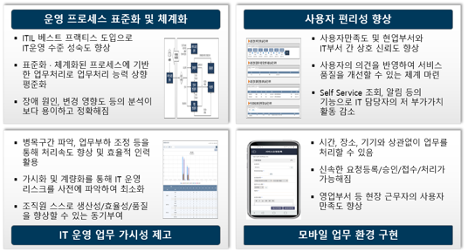
For processors, ITSM allowed task handling from home, using a unified portal for requests and processing.
For requesters, ITSM provided visibility into task progress without the need to visit the office or search for contact details. Mobile ITSM further enhanced efficiency, and automated notifications ensured timely task awareness and completion—all without disrupting existing workflows.
Figure 1. Implementation Benefits (GC Green Cross ITSM Project)
Developer Perspective
From a development standpoint, the project leveraged the Build Management Component, reducing unnecessary time spent during system setup. This component facilitated communication between system administrators, developers, and users, enabling collaborative requirement discussions and reviews. During the one-month prototype phase, TF team interactions were managed through this component, minimizing meetings and fostering horizontal feedback. As a result, project efficiency improved significantly.
This experience demonstrated that future system implementations can succeed remotely by utilizing such components, even without on-site presence.
Lessons Learned
Before ITSM adoption, most stakeholders underestimated its necessity. Post-implementation, they recognized its value—especially in today’s evolving work environment. Unexpected challenges like COVID-19 highlight the importance of building IT systems that support remote operations.
Currently, ITSM solutions and other systems enabling non-contact workflows are gaining attention. As the title suggests, ITSM can evolve into the optimal system for supporting Untact culture. I hope this case study illustrates its potential.
Ahn Hyo-Jeong, Assistant Manager, Lightning Team, STEG Inc.