
 Contact

Community
Finding Ways to Foster Personal and Organizational Growth for Company Success
- Date2020.12.21
Finding Ways to Foster Personal and Organizational Growth for Company Success
Employees are a company’s most valuable asset. A company with highly skilled employees, one that helps its employees develop their capabilities, is better positioned for sustainable growth. The individual growth of employees ultimately contributes to the company’s success.
While reading various self-development books, I discovered methods that can help both individuals and organizations grow, benefiting the company as a whole. I’d like to share these insights.
How Can Individuals Grow Within a Company?
Everyone spends the same eight hours at work each day. If employees can handle tasks more efficiently within this limited time, the company will achieve its goals more easily. Consider two employees, A and B, with the same rank and salary. If their output differs significantly, the company incurs a loss.
The more employees work efficiently, the more stable the company’s growth will be. So, how can individuals work more effectively? They need to set long-term goals to avoid getting lost in short-term tasks and missing essential work. Here are two effective methods for identifying and prioritizing core tasks:
1. The Mandal-Art Technique
Developed by Japanese designer Hiroaki Imaizumi, the Mandal-Art technique gained fame as Shohei Ohtani’s goal-setting method. Many global business leaders, athletes, artists, and celebrities have used Mandal-Art to achieve remarkable results.
The technique involves setting a final goal and then breaking it down into actionable ideas and solutions. Ohtani’s example is widely available online and on YouTube. Individuals can adapt this method to define and visualize their goals and execution plans for personal growth within the organization.
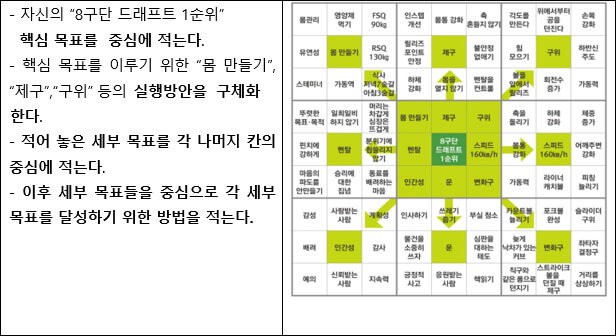
This approach helps organize thoughts and provides a clear view of actionable ideas at a glance.
2. The OKR Tool
OKR (Objectives and Key Results), created by Intel CEO Andy Grove, is a performance management method adopted by global companies like Google, Spotify, Airbnb, and LinkedIn. It supports both individual and organizational growth, making it ideal for collaborative goal-setting.
OKR consists of two elements:
- Objectives: Specific, action-oriented goals
- Key Results: 3–5 measurable outcomes that indicate goal achievement
Key results should logically lead to achieving the objective. Leaders play a crucial role in helping team members allocate time effectively and prioritize tasks aligned with mid- and long-term goals.
Setting Priorities
Once goals are established, the next step is prioritizing tasks. Andrew Carnegie and Frederick Taylor’s famous anecdote illustrates this: Carnegie offered $10,000 for valuable advice, and Taylor replied, “Write down the ten most important things you can do. Start with number one.”
This highlights the importance of prioritization.
Two well-known methods for prioritizing tasks:
- David Allen’s GTD System: Collect all tasks, categorize them (do immediately, discard, delegate), and create an actionable list based on priority. Review and update regularly.
- Warren Buffett’s Strategy: List 25 goals, select the top five, and discard the rest to maintain focus.
Leaders must consider existing workloads before assigning new tasks and adjust priorities through discussion to ensure balanced time allocation.
Avoiding Planning Errors
Plans often fail due to unrealistic time estimates or overlooked obstacles. To avoid this, create smaller, flexible plans that can adapt to changes. If a plan fails, don’t give up—reassess and create a new plan. Success after multiple iterations still counts as overall success.
Leaders should monitor progress, especially for unfamiliar tasks, and provide timely support. If deadlines are missed, adjust schedules and involve other team members as needed. Always build buffer time for unexpected delays.
Final Thoughts
Don’t waste time on elaborate plans—start with small, actionable steps. While popular methods can help, the best approach is finding one that works for you. Personally, I recommend starting with the Mandal-Art technique for individual growth and using OKR for combined personal and organizational development.
References: “Work Smarts: Start with Priorities” by Lee Hyung-Kyu, Senior Researcher (Samsung Economic Research Institute, sericeo.org); Various resources on Mandal-Art and OKR.
Oh Yeon-Ji, Assistant Manager, PS2 Team, STEG Inc.