
 Contact

Community
‘Evolved’ SLA Provided by E-GENE™ SLM Solution: Case Study of SLA Implementation at Heungkuk Life Insurance
- Date2021.08.06
‘Evolved’ SLA Provided by E-GENE™ SLM Solution: Case Study of SLA Implementation at Heungkuk Life Insurance
STEG provides the best service through the E-GENE™ SLM solution to help companies achieve their goals, meet expected service levels, and reduce costs. Throughout the process of building and managing SLA processes across various sites, “data integrity” and “consistency” have always been emphasized. Furthermore, expressing the wide range of services offered by ITSM systems in quantifiable metrics has been a persistent challenge for STEG, which focuses on customized consulting from diverse user perspectives.
In this article, based on the SLA process implementation case from the recently completed “Heungkuk Life Insurance IT Service Management Culture Improvement Project,” I will explain from two perspectives how we approached the project and provided service level evaluations tailored to Heungkuk Life Insurance using our SLM solution.
1. Implementation of Various Measurement Indicators
In this project, Heungkuk Life Insurance wanted not only evaluation indicators that assess service levels by linking services provided among customers, internal organizations, and external vendors into contracts, but also a way to represent evaluations of various ITSM processes quantitatively and transparently. To meet these requirements, Heungkuk Life Insurance’s measurement indicator system was implemented in two categories: SLA evaluation indicators based on contracts and management indicators that measure the proper execution of IT operations processes. This allowed measurement of both service levels and process execution levels.
(1) SLA Evaluation Indicators
Since the fulfillment of agreed service levels between the service provider and the client is critical, the priority was to make this as visually clear as possible on the screen. Therefore, we displayed monthly overall scores and grades according to the contract, incentive/penalty status based on compliance, and detailed status and trends for each indicator in a dashboard format. For types of implemented indicators, refer to “KPI Talk” on our company website for examples of various indicator types.
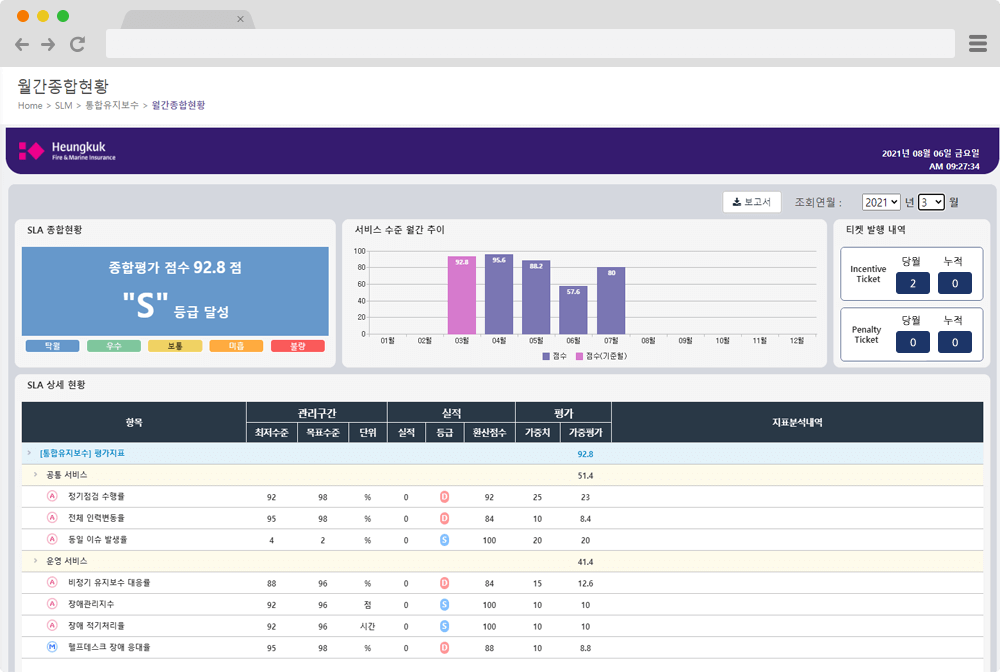
<Figure 1. Monthly Overall Status Screen>
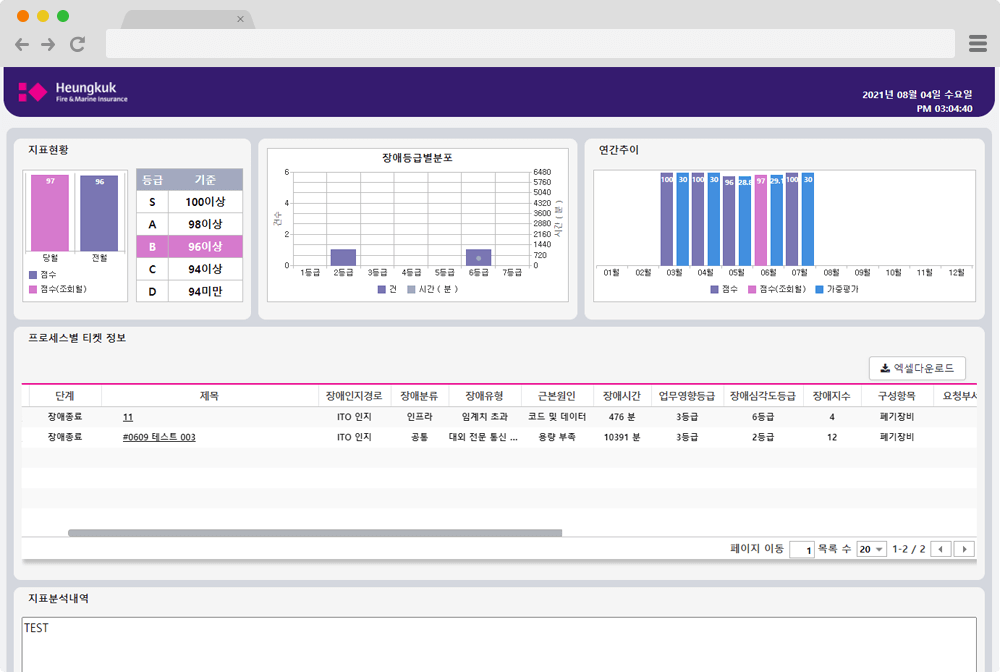
<Figure 2. Detailed Screen by Indicator>
(2) Process Management Indicators
Although process execution level evaluations can be sufficiently implemented and visualized through statistical/reporting functions, considering diverse user perspectives, we decided to design the system using the SLM module, which enables customized data provision. Unlike evaluation indicators, these do not involve contracts, so instead of screens showing overall scores and grades, we configured simple displays showing scores and detailed status for indicators categorized by process area.
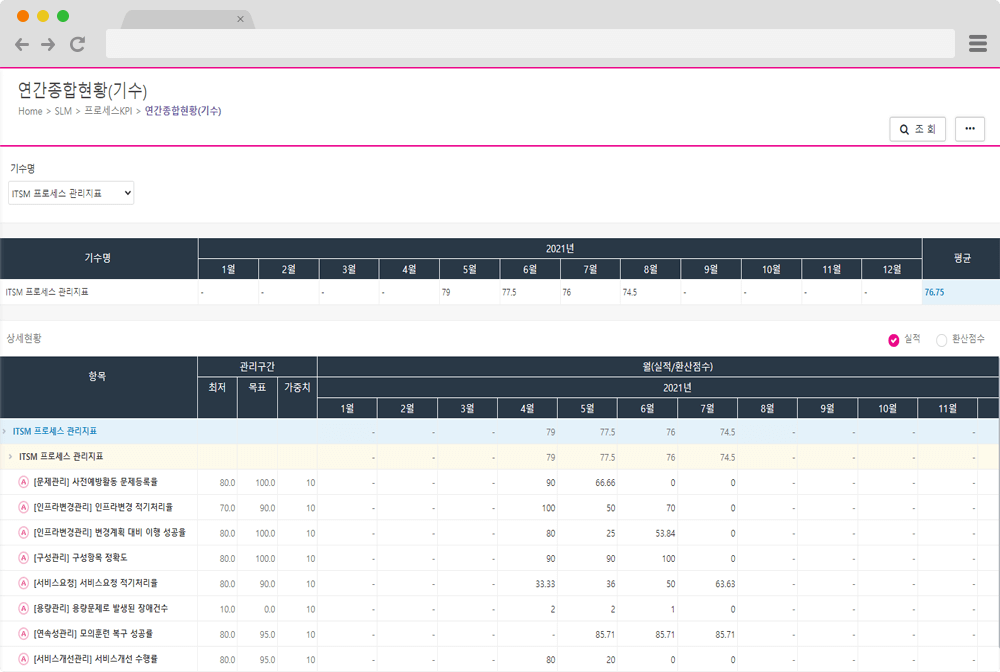
<Figure 3. Annual Overall Status Screen for Project Management Indicators>
Our E-GENE™ SLM solution has the advantage that if the “service catalog” is properly defined, service level measurement is possible through automation tools even with distributed data. By leveraging this, management indicators can also be efficiently evaluated objectively based on data by setting virtual contracts, service groups, and services and defining process-specific indicators. At Heungkuk Life Insurance, management indicators enabled measurement of process execution levels across multiple areas, including incident, problem, and service request management, as well as availability/capacity/continuity management, IT project/planning management, and service improvement management.
2. Complete Automation of Measurement Indicators
Previously, some indicators at Heungkuk Life Insurance were managed manually using Excel, which inevitably led to “data consistency” issues. Through this improvement project, we automated all indicators by configuring and managing them based on ITSM data, reducing the burden on staff.
For example, there is an indicator called “Regular Inspection Activity Appropriateness Index,” which measures whether annual planned inspections are properly executed. Previously, staff manually counted planned and executed inspections and entered them for measurement, which was inconvenient. To resolve this, we first configured the “Integrated Maintenance Performance Management” process to manage regular inspection performance, enabling automatic measurement of monthly planned inspections and automatic calculation of appropriate execution counts based on entered performance data.
Another example is the “Personnel Change Management Rate” indicator, which was previously managed manually to track changes in service provider personnel. We automated this by systematizing personnel management functions and processes for personnel deployment, withdrawal, and handover, then recalculating un-replaced and re-replaced personnel after indicator measurement to apply weighted score deductions for final weighted evaluation. This eliminated the inconvenience of manual management and additional calculations.
As the person in charge of the SLA process implementation part of the Heungkuk Life Insurance IT Service Management Culture Improvement Project, I reflected again on the word “evolution,” which STEG always emphasizes. Providing even slightly better convenience through our service technology tailored to the customer’s perspective is, in my view, the process of “evolving.” Although the SLA process used in Heungkuk Life Insurance’s existing system was operational, with a little creativity and willingness to improve, we were able to move toward a more advanced system and management framework than everyone expected. I conclude this article with the expectation that the E-GENE™ SLM solution will be the best solution for building various SLA processes.
Park Ga-Young, PSP Team, Solution Service Division, STEG Inc.