
 Contact

Community
Understanding and Designing IT Planning Processes
- Date2021.12.16
Understanding and Designing IT Planning Processes
This guide is intended to help those who find IT planning terminology and tasks unfamiliar, making it easier to understand, analyze, and design processes. The content is based on my experience with projects for NICE Group and Heungkuk Fire & Marine Insurance. For more visualized materials, please refer to the attached documentation.
1. Understanding IT Planning Tasks
IThe general flow of IT planning involves setting an annual budget for planned projects, reviewing and approving these projects, contracting with selected vendors, and making payments as projects progress.
The process can be divided into three main areas:
- Budget planning
- Project review and approval
- Contracting and payment
Detailed steps:
To establish a budget, the IT project or budget management team requests annual budget proposals from individual project managers or departments. These proposals are then reviewed for feasibility and prioritized based on importance. Approved budgets typically cover two categories:
- Investment projects (e.g., new system implementation)
- Expense projects (e.g., maintenance, network fees)
When it’s time to execute a project, technical, security, and quality reviews are conducted. Depending on the contract type:
- Competitive bidding: Includes public announcements, RFPs, evaluations, and negotiations.
- Direct contracting: Involves selecting a specific vendor without bidding.
After reviews, projects requiring significant investment or importance undergo committee or council approval before execution. Once approved, contracts are signed, payments are made, and the contract is closed. If additional funds are needed or new projects arise, extra budgets are allocated or transferred from remaining funds.
2. Designing IT Planning Systems
Based on the workflow, processes can be grouped into:
- Project Planning
- Project Execution
- Project Implementation
Design should focus on registering and managing the results of offline tasks.
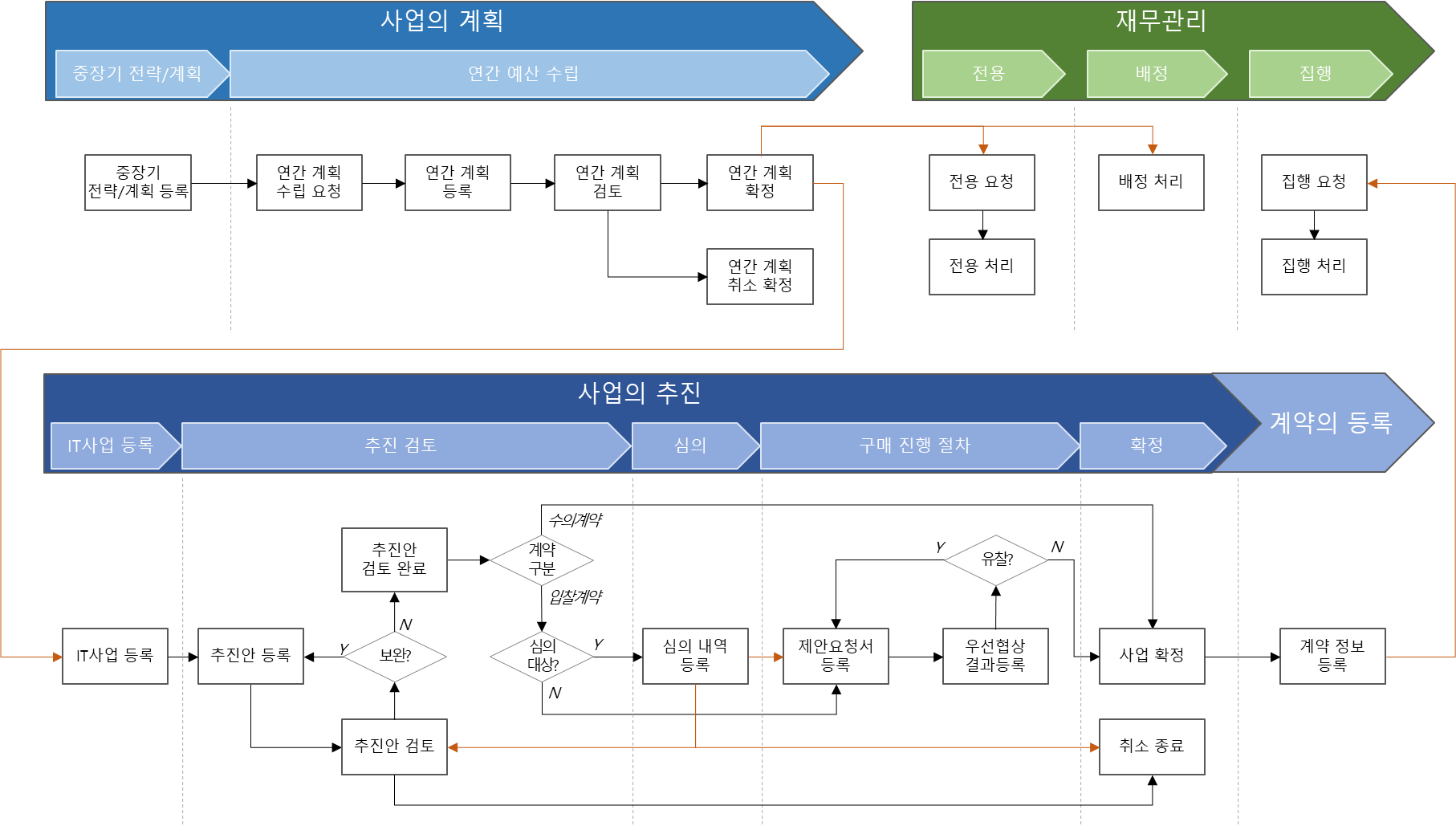
Example: Heungkuk Fire & Marine Insurance IT Planning Process Design
Project Planning:
Register mid- to long-term strategies and link them to annual budget requests. Budget requests can be managed via sub-tickets for specific departments or through main tickets for broader participation. Include review and prioritization steps, and separate screens for investment vs. expense budgets.
Project Execution:
Register investment projects (not recurring expense projects). Maintain links to strategic plans and allow input of technical, security, and quality review data. If roles are clearly defined, use sub-tickets; otherwise, input data in the main ticket. After reviews, projects proceed to approval workflows, which often involve batch reviews of multiple projects. Add logic to update project status based on approval results. For bidding contracts, follow procurement workflows; for direct contracts, proceed to confirmation.
Contract Registration:
Manage contracts in a separate workflow, as one project may have multiple contracts. Include links to related projects, contract amounts, and payment schedules. Allow modifications for contract changes.
Financial Management:
Separate workflows for execution, transfer, and allocation:
- Execution: Payment processing during project implementation, with tracking of remaining contract balances.
- Transfer: Move funds between budgets, typically within the same account code.
- Allocation: Add extra funds to increase a budget.
3. Design/Implementation Considerations
Relationships between strategies, annual plans, projects, and contracts should follow 1:1 or 1:N structures—avoid N:N relationships.
Consider integration with asset management processes after contracts, and decide whether to link configuration items to contracts or vice versa.
IT planning often involves numeric controls, heavy data loads, and complex calculations, so performance optimization and script handling are critical.
Attachment: 2021_IT Planning Training Material – Lee Junhyuk
STEG Solution Service Division – PSP Team, Deputy General Manager Lee Junhyuk