
 Contact

Community
Service Level Evaluation from a Financial Perspective
- Date2022.02.22
Service Level Evaluation from a Financial Perspective
ITO (IT Outsourcing) Pricing
In today’s rapidly changing business environment, IT outsourcing is recognized as an essential strategy for maximizing productivity and profitability. The market continues to grow, and in the case of public institutions, nearly 60% of their IT budgets are spent on system operations and maintenance.
Experts predict that IT outsourcing will go beyond cost reduction and become a critical means of securing specialized expertise. However, most organizations still calculate IT outsourcing costs based on labor input, which often leads to unrealistic pricing that neither clients nor vendors find acceptable—creating ongoing controversy in the market.
To address these issues, the Korea Software Industry Association revised the existing pricing model in 2015, introducing a value-based IT service pricing model that considers customer characteristics and service capability levels when determining outsourcing costs. In 2021, the association released the Service-Level-Based IT Outsourcing Pricing Model.
According to the association:
“This guide aims to provide diverse standards for ITO pricing, broaden choices, encourage rational and objective pricing between service providers and consumers, and promote fair transactions.”
This article discusses service level evaluation from a financial perspective as a method for IT outsourcing pricing.
Basic Application of SLM (Service Level Management)
The SLM process defined in ITIL ensures that IT services provided by an organization support business needs and meet agreed service levels. Its purpose is to maintain current IT service quality at a reasonable cost and gradually improve service quality through repeated SLM cycles.
To achieve this, SLM must be defined for all IT services, including SLA agreements and OLA/UC definitions for internal and external providers. Furthermore, SLM must be linked to business and financial elements.
ITIL specifies that SLM processes should follow Plan-Implement-Execute-Control stages. In practice, SLM implementation typically involves five steps:
1. Define service scope and content
2. Select service level measurement indicators
3. Set service level targets
4. Establish SLA agreements
5. Operate and improve
Service level evaluation generally uses KPIs defined in the SLA. Each KPI is assigned a weight, and performance is measured periodically. The evaluation score is calculated by multiplying achievement by weight, and the sum of all KPI scores determines the overall rating.
○ Indicator Evaluation: Achievement × Weight

○ Overall Evaluation: Sum of all indicator scores

Weights should total 100. Additional points or deductions can be applied for specific indicators or overall scores (e.g., adding 1 point for proposing or implementing improvements).
Financial Perspective in Service Level Evaluation
The results of SLA-based service level evaluations can be used to calculate penalties and rewards, enabling financial-based assessments. For example, overall ratings can be categorized as Excellent, Good, Average, Poor, and Unsatisfactory, with penalties/rewards applied to the extremes. The total penalty/reward amount cannot exceed the monthly allocated budget.
○ Penalty/Reward Calculation:
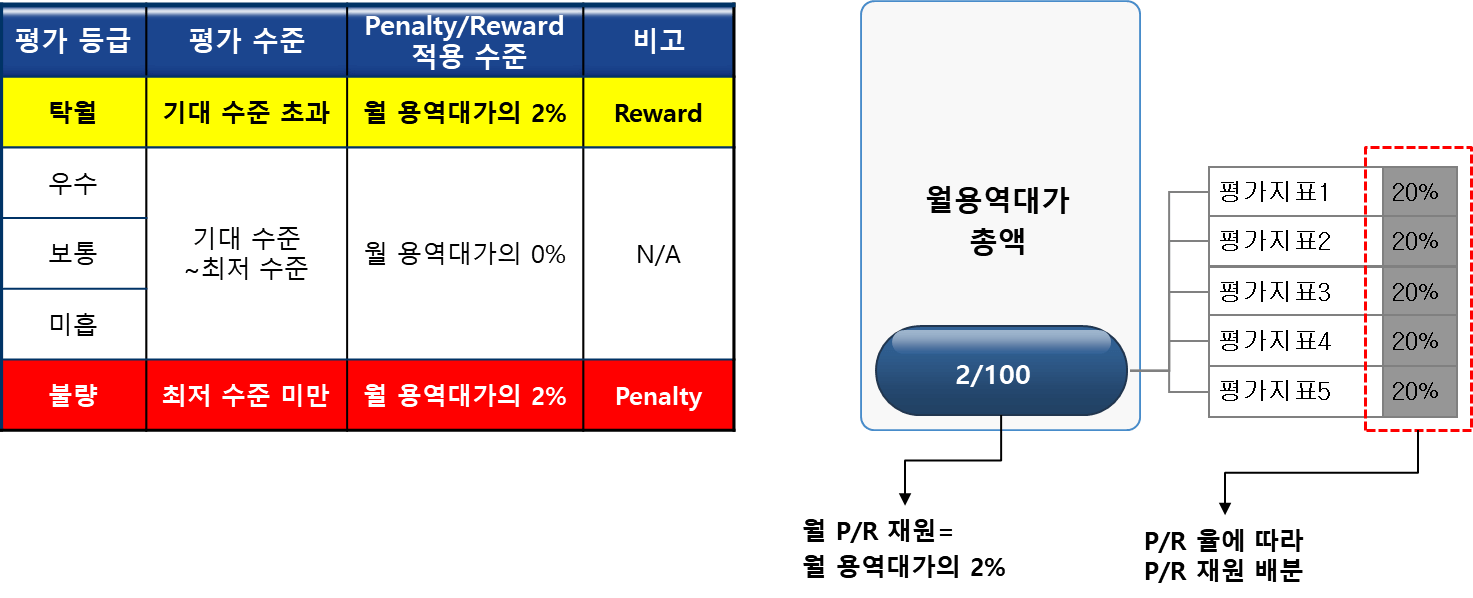
Each indicator is assessed individually, and the SLA’s total penalty/reward amount equals the sum of all indicator-based calculations.
Example:
If the total contract value is 2.4 billion KRW, the monthly fee is 200 million KRW. The total penalty/reward fund is 2% of the contract value (48 million KRW), with a monthly allocation of 4 million KRW.
○ Penalty/Reward Example
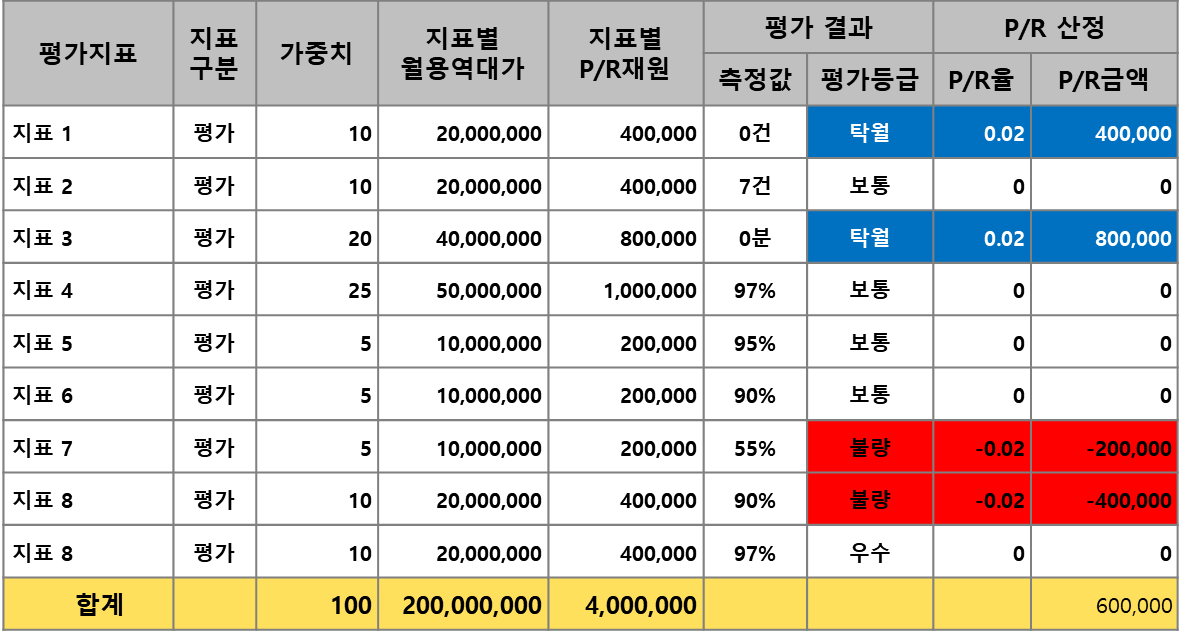
In some financial sector cases, monthly payments include a fixed amount plus performance-based incentives. For example, if the monthly contract is 1 million KRW, with 800,000 KRW fixed, the remaining 200,000 KRW is paid based on overall service evaluation (Excellent, Good, Average, Poor).
While financial-based service level evaluation is not the only method for IT outsourcing pricing, it is one of the most objective and fair approaches. ITIL’s SLM process should not be seen as a tool to control providers but as a communication mechanism between providers and users, aimed at improving service quality and reducing costs—the ultimate goal.
Reference: Information & Communication Newspaper (http://www.koit.co.kr)