
 Contact

Community
What Makes a Good Company? Understanding Through Contribution Margin
- Date2022.12.28
Changes in Implementation Methodology Through E-GENE Metadata Management
What makes a good company?
Is it a company that guarantees work-life balance? A company that pays high salaries? One with great benefits? A horizontal and free atmosphere? Job security? High potential for personal growth? Reasonable workload? Strong brand recognition? Social value realization? There are many conditions, but to meet and maintain these conditions, the company must first generate sufficient profit. This also requires a deep understanding of financial perspectives.
Here are some companies in crisis:
Their cumulative investment amounts are as follows:
- Tal-ing (approx. KRW 18.7 billion)
- Today’s Hoe (approx. KRW 21.8 billion)
- Watcha (approx. KRW 56.7 billion)
- Sandbox (approx. KRW 91 billion)
- Vroong (approx. KRW 176.2 billion)
Tal-ing, a hobby education platform, is reportedly under emergency management due to poor investment attraction. Today’s Hoe is said to have sold out all products and is conducting layoffs. OTT platform Watcha is struggling to maintain content as subscriber growth falls short of expectations and is selling its management rights. Sandbox faces structural challenges because influencers own content rights, making it hard for agencies to profit. Vroong, a motorcycle delivery company, reportedly cannot pay building rent.
Why have companies that received large cumulative investments fallen into crisis? The common factor is that they all lack contribution margin. So, what is contribution margin?

To make it easier to understand, here’s an example:

Subtract operating expenses (variable and fixed costs) from revenue, and you get operating profit. Contribution margin refers to revenue minus variable costs. Essentially, contribution margin equals operating profit plus fixed costs. Fixed costs are expenses incurred regardless of sales—such as salaries and rent—that must be paid monthly.
Variable costs are expenses related to business activities. For example, selling a product requires packaging and delivery. These costs increase proportionally with revenue. Contribution margin fights against fixed costs: if contribution margin exceeds fixed costs, the company makes a profit; if it falls short, there is no operating profit.
From this perspective, business is essentially a battle between contribution margin and fixed costs.
What should managers do to generate profit? There are two ways:
Increase contribution margin.
Reduce fixed costs.
How do you increase contribution margin?
Increase revenue or reduce costs per sale, such as packaging, material costs, and sales commissions. Raise the unit price or identify variable costs per transaction and figure out how to lower them.
Many assume that higher sales lead to economies of scale, but companies without contribution margin will never achieve operating profit—even with KRW 10 trillion, 20 trillion, or 100 trillion in sales. While revenue growth is expected to improve efficiency and profit margins, variable costs rise proportionally with revenue, limiting economies of scale.
Below is Market Kurly’s income statement for 2020 and 2021:
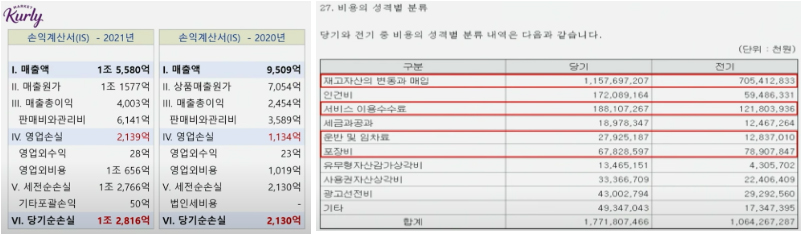
Market Kurly’s cost of goods sold ratio is 74%, and its revenue growth rate is 64%, which is strong. However, its operating margin worsened from -12% to -14%. Major variable costs rose from KRW 919 billion to KRW 1.4415 trillion, while revenue increased from KRW 950.9 billion to KRW 1.558 trillion. Market Kurly’s contribution margin ratio improved from 3.4% to 7.5%.
To achieve profitability, contribution margin should be at least 15–20%. High fixed costs and low contribution margin indicate inefficiency. Improving contribution margin means raising unit prices, reducing production costs, optimizing packaging and delivery, and streamlining logistics to lower procurement costs.
Below is the 2021 income statement for Laundry Special Forces and LaundryGo:
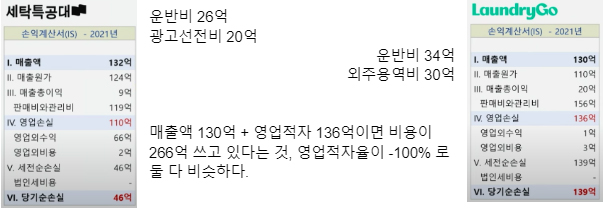
Laundry services incur high costs for operating laundry plants and labor for pickup and delivery. A high cost-of-goods-sold ratio means these companies would need to double their unit prices to break even. While they aim to reduce laundry costs through automation (a fixed cost issue), the real challenge is reducing variable costs.
Selling below cost and hoping efficiency improves with scale is unrealistic. Delivery and laundry are labor-intensive, and labor costs do not decrease easily. Commerce and service businesses relying on human labor have inherently high variable costs, such as shipping and delivery. These companies attract customers because they are cheap, but structural contribution margin remains low.
Why do companies without contribution margin continue to exist?
Because they have attracted significant investment based on revenue and user traffic. There is a belief—almost like faith—that changing customers’ lives guarantees profitability. The mantra has been: “Just gather users, and success will follow,” like Kakao. While providing value to customers is admirable, sustainability must now be considered. Businesses are not short-term ventures; they must last. Without sustainability, growth is impossible.
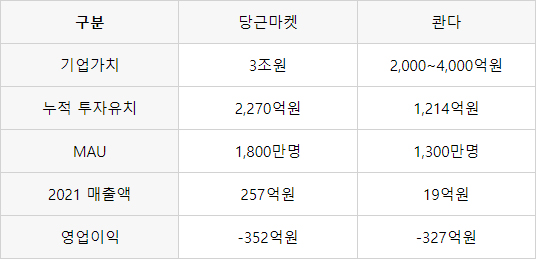
These companies have a huge gap between enterprise value and revenue. Operating losses exceed revenue, yet they attract investment because of high MAU (Monthly Active Users)—e.g., 18 million for one company, nearly the entire Korean population. QANDA, a math problem-solving app, attracted investment because it has 13 million MAU. While these companies may not always have low revenue, their sales occur much later than their growth stage, meaning revenue generation is delayed.
Investors assume that since these businesses lack variable costs, they can focus on acquiring users first and later attach monetization models for large revenue.
But is that really true?
If a company grows only by increasing users, its DNA does not include profit-making strategies. When it finally tries to monetize, it doesn’t know how. The idea of delaying profitability worked in the 2000s, but in the 2020s, companies must grow while considering revenue. There will never be another KakaoTalk. Competition is fierce, and market leaders have already emerged. Companies that succeeded by amassing users have already peaked. If a company suddenly tries to monetize after conditioning customers and employees to free services, customers will resist and threaten to leave.
We’ve looked at companies with high traffic but low revenue. A good company is one that generates contribution margin and profit. To understand how to increase contribution margin, you need financial literacy. Selling more does not guarantee profitability. Balance is key: reduce variable costs and increase revenue. Companies that only chase growth without learning how to make a profit will fail, and those that obsess over profit may stunt growth. Integration is essential. Only companies that combine these elements—development, sales, marketing, stability, and progress—will become major players. Solutions that balance these factors are needed.
Additionally, companies need “midfielder-type” leaders who can harmonize offense and defense—growth and stability. A good company is one that always asks, “What’s next?” and plans together.
Yeon-Ji Oh, PS2 Team, STEG Inc.
Reference: The Fatal Chronic Disease of Loss-Making Companies (CPA Lee Jae-Yong)
https://youtu.be/LZV0bEdIcgY