
 Contact

Community
Data Management on No-Code Platform – Hierarchical Data
- Date2022.12.28
Data Management on No-Code Platform – Hierarchical Data
The purpose of a system, or application, is to provide services that users want, and the system consists of a large amount of data that delivers various information to users. Data includes user-generated data and data managed to provide services.
In a database, rows are called records or tuples and are classified and managed as either list-type or hierarchical-type depending on the data structure.
List-type data is the most basic data structure and is managed in our solution using eGeneList, while hierarchical data is managed using components suited for hierarchical structures.
In this article, we introduce hierarchical data management in the E-GENE solution and discuss its evolution in the No-Code era.
Hierarchical data refers to a tree-structured data model where parent-child relationships are repeatedly formed. Examples include menu structures in a system and department data divided into upper and lower levels.
One of the first considerations in system development and a critical element during implementation is designing the data model and determining how it will be managed within the system.
Although hierarchical data models may seem complex because they require repeated parent-child relationships, they can be simply constructed with just two columns: a unique ID and a parent ID (pid). When an entity is created, a primary key is generated, and adding a pid column completes the design for a hierarchical data model.
Next, queries must be written to retrieve hierarchical data. Databases provide functions for hierarchical data queries, but these differ by DB, so you need to understand each syntax. Below are examples of hierarchical queries for Oracle and MariaDB.
Hierarchical Data Construction
To build hierarchical data, knowledge of SQL is required. You must also use functions specific to hierarchical data, which vary by DB.
Oracle uses the START WITH… CONNECT BY function to construct hierarchical data, completing queries using only id and pid as shown in the sample below.
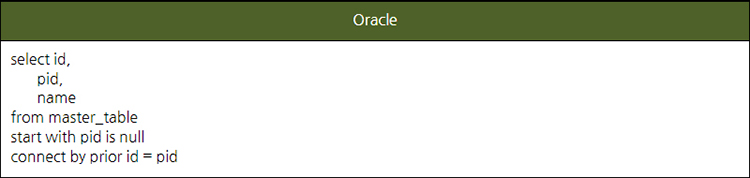
MariaDB uses recursive queries to build hierarchical data, completing queries using virtual table information as shown in the sample below.
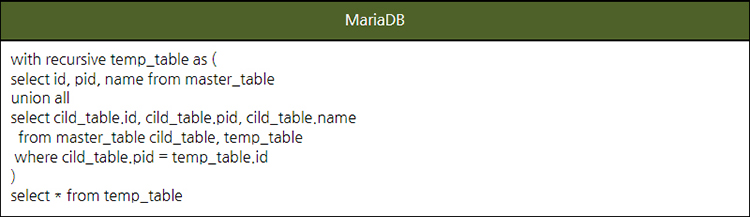
Managing Hierarchical Data with Tree & Form
The E-GENE XTREE UI provides a screen for managing hierarchical data. With XTREE UI, you can configure a high-level management interface without coding, using only hierarchical data SQL and Form UI settings.
In the menu management screen shown below, hierarchical data is added using the Add button, and detailed information is managed through Form UI configured according to data type. This reduces errors caused by user mistakes that could lead to system issues.
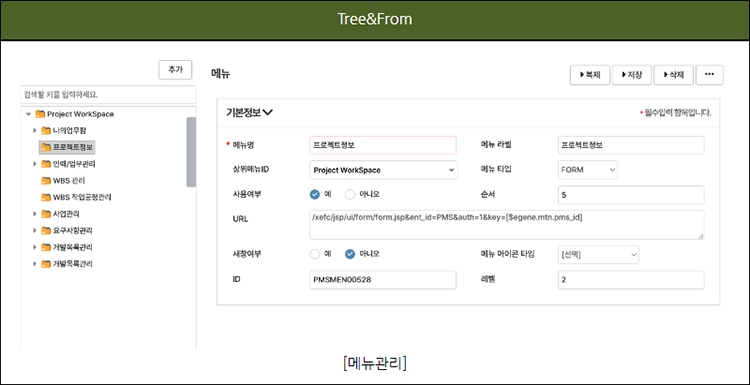
Tree & Form for Hierarchical Data Management
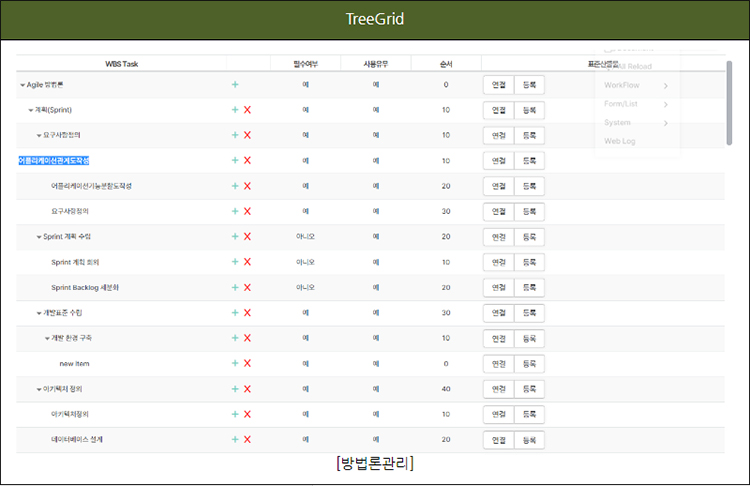
This is the most basic hierarchical data management screen. Similar to editing Excel data, users can modify data at the cell level.
TreeGrid allows intuitive data management by adding or deleting child data using + and x buttons. It includes cell-level editing and real-time saving features, offering user-friendly editing capabilities.
No-Code Hierarchical Data Management
Currently, the relationship management screen requires SQL for configuration, so it is more low-code than fully no-code. Basic tasks include entity creation, selecting management data, generating hierarchical SQL, configuring XTREE screens, setting up Form UI, configuring xtreeList, menu settings, and assigning menu permissions.
To effectively build management screens, users need basic knowledge of the package and some ability to use it for application development.
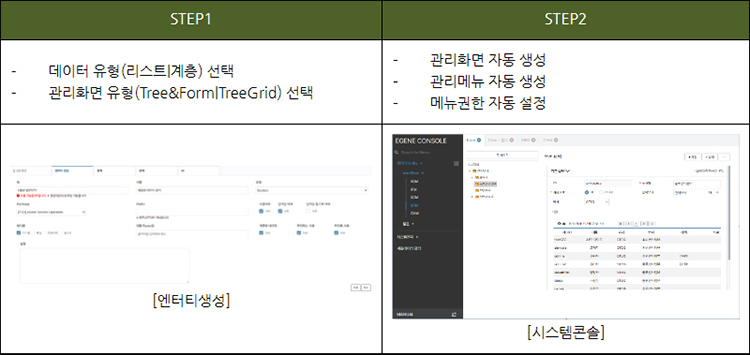
How to Achieve True No-Code for Hierarchical Data?
To enable seamless data modeling and management in the No-Code era, the ideal approach would be to template all processes required to configure a management screen so that after creating an entity table, data can be viewed immediately from the management menu.
Our E-GENE platform is a No-Code platform equipped with numerous modules such as Entity, SQL, LIST, RELATION, and MAPPING, which are essential for application development. This allows citizen developers to easily participate in application development projects.
Furthermore, if we template core application components for automatic configuration, the platform will evolve into a highly versatile No-Code solution capable of building advanced systems in a short time. We look forward to seeing these changes in E-GENE in 2023.
Jae-Hak Ko, R&D Team, STEG Co., Ltd.