
 Contact

Community
Moving Forward with E-GENE Solution Aligned to NCLC Agile Methodology
- Date2023.12.11
Moving Forward with E-GENE Solution Aligned to NCLC Agile Methodology
There is often a misconception that Agile is a set of rules that dictate development tasks. However, Agile is not a series of regulations for development work; rather, it is a perspective on workflows and operations. It should be understood as a value system that guides choices about what to build throughout the entire software development lifecycle. This is the correct approach.
STEG implements and provides services based on its own defined E-GENE Agile development process, aligned with this value system.
In this article, we introduce E-GENE modules that help realize the essence of Agile—creating good things quickly and without waste—through the NCLC E-GENE Agile methodology. We will also present management modules and functions tailored to each process stage, from prototype creation to user experience, implementation, testing, and deployment.
Requirements – Prototype User Experience
STEG offers Korea’s only all-in-one package that includes ITSM, PPMS, and ESM as a service. Before adopting the solution, users and companies can experience the embedded processes and numerous features of ITSM, PPMS, and ESM within the E-GENE platform. This allows them to verify the quality and configuration of the solution and clearly define requirements and strategic directions.
Design – Real-Time Output Focus, Two-Way Feedback
The E-GENE platform provides cooperation tools that are immediately visible, such as Sprint, PMS, web documents (WIKI), E-GENE Drive (Webhard), comments, feedback, and Gantt chart work instructions (WBS). These service modules minimize paperwork through project and document management, placing the customer at the center of the development process and ensuring that customer requirements are met at every stage.
Implementation (Requirements) – Fast and Waste-Free Screen Development Using Built-In Standard Interfaces
As a No-Code/Low-Code (NCLC) platform, E-GENE visualizes workflows to reduce waste caused by procedures and formats, enabling rapid implementation. It offers modules such as Workflow (process management), Data Modeling (entity management), Form Designer (UI creation tool), SQL Builder, List Wizard, Data Adapter, Dashboard Builder (service level management), and mobile support (iOS, Android). Additionally, it provides reusable interfaces as Low-Code plug-ins for tasks like version control (SVN, Jenkins), AD account synchronization, electronic approval, SAP integration, and notification systems. Integration tools such as ETL (DB to DB), real-time events (API), file import (File to DB), and EAI/ESB (Control Hub) enable easy connection to external systems.
Testing – Continuous Results and Iterative Testing for Perfect Response
The E-GENE platform offers flexible and fast visual testing environments at each stage, allowing quick evaluation of results from ongoing business logic changes. Through iterative testing, it rapidly addresses and improves requirements to meet customer needs.
Version control, patch management, and log management enable agile and responsive operations, ensuring continuous alignment with users.
Deployment – A System Where Each Result Becomes Feedback for the Next
Using Dashboard Builder, the E-GENE platform provides real-time information on IT processes, SLAs, and service indicators, enabling quick operational decisions and strategic planning. Automated deployment management and an internal service desk for handling errors and improvements ensure rapid response. Additionally, STEG operates a technical forum Resource Center and monthly bootcamp training sessions to provide ongoing learning opportunities for the E-GENE platform.
As described above, by using STEG’s E-GENE NCLC Agile Model, projects can be completed within a short period of 2–3 months with reduced effort, significantly cutting project duration and costs through structured service modules.
In contrast, the traditional Waterfall Model requires documenting requirements, prioritizing them, designing to meet those requirements, and then starting implementation. After implementation, the product’s functionality is checked against the initial objectives, and if it does not meet them, requirements must be redefined. This sequential process—testing → requirements analysis → design → implementation → testing—typically results in project durations of 5–10 months and requires substantial effort.
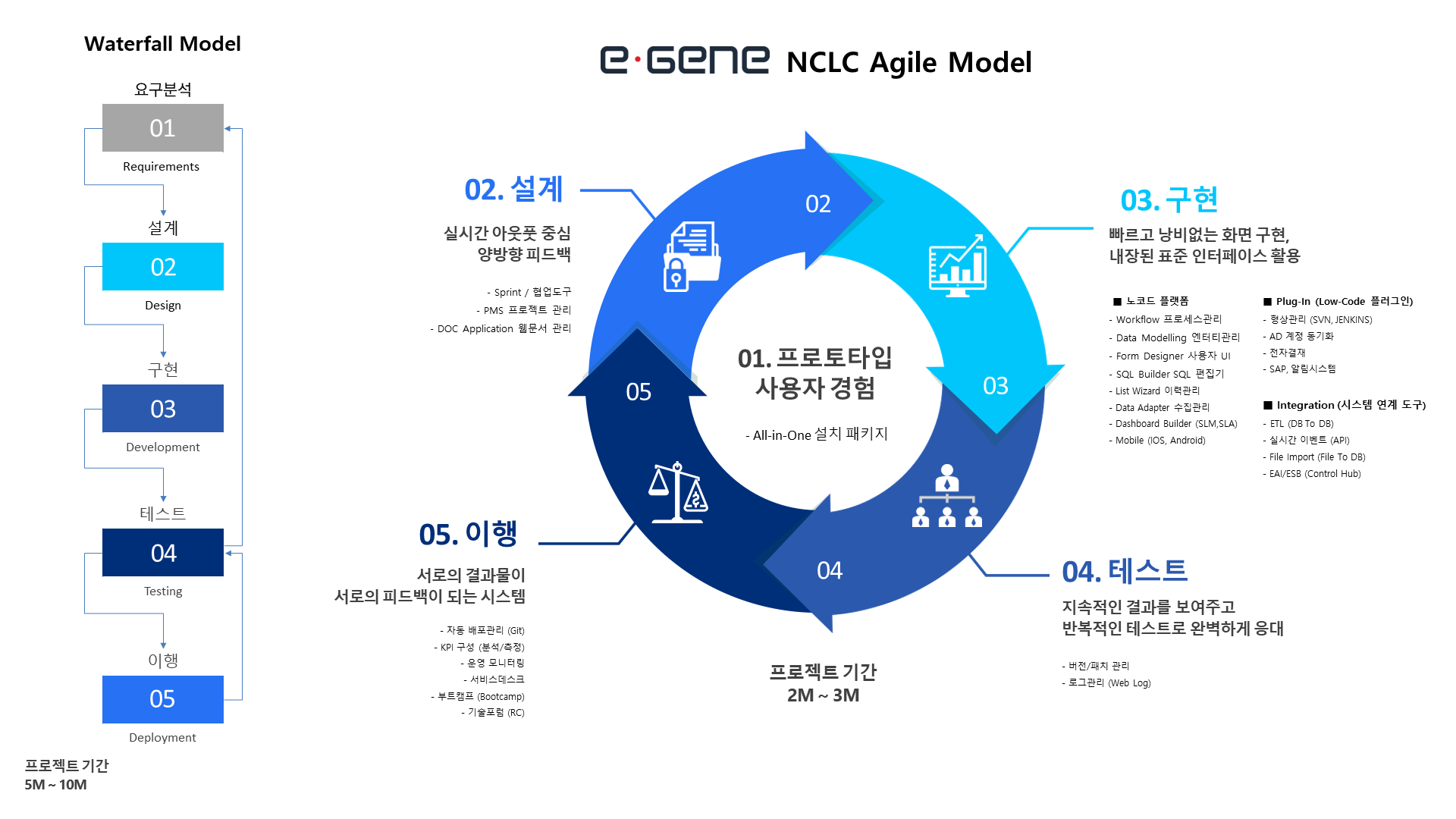
[Traditional Waterfall Model vs. STEG NCLC Agile Model]
STEG continues to embed various service modules into its products based on Agile methodology, not only realizing greater value for the E-GENE solution but also proving its steady growth as a No-Code/Low-Code (NCLC) platform provider.