
 Contact

Community
Background and Core Changes of ITIL V5
- Date2026.05.28
Background and Core Changes of ITIL V5
Announced in 2019, ITIL V4 significantly overhauled ITIL V3 to address the digital transformation of business processes and cloud-centric environments. Seven years later, ITIL V5 has arrived. The rapid advancement of AI technology and the proliferation of digital product-centric operating models have made it difficult for ITIL V4 alone to adequately address today's modern environment. Let's explore the new ITIL V5, which maintains the strengths of traditional ITIL while evolving to fit an AI-driven, digital product-centric ecosystem.
1. Shift in Demands Due to the Rise of AI
AI is no longer just an analytical tool; it has become a core component of the decision-making process. From automatically calculating service demand to evaluating operational risks in real time, organizations are shifting from a model where "humans decide and AI assists" to one where "AI decides and humans verify."
AI and automation are reshaping the operating model itself. While ITIL V4 emphasized automation, it was not designed for an environment where AI actively drives operations. In the AI era, AIOps has driven a shift from human-operated systems to those run by AI and supervised by humans.
As AI integrates into decision-making, organizations face new responsibilities, including:
ㆍExplaining the rationale behind AI decisions
ㆍManaging data bias
ㆍEstablishing control systems for AI malfunctions and misjudgments
ㆍEnsuring regulatory compliance (such as privacy laws and automated decision-making regulations)
ITIL V5 embeds this AI governance as a core component.
AI has also fundamentally changed service architecture. Service design and operations are no longer just about traditional IT service management; they now unify AI model management, data management, and service management into a single discipline.
ITIL V4 had structural limitations in addressing the AI-centric decision-making frameworks, AI-driven automation, AI governance, and AI-based lifecycles brought by this new era. While ITIL V4 captured the cloud and digital transformation wave, the widespread reorganization of business operations through AI necessitated the launch of ITIL V5.
2. Proliferation of Product-Centric Operating Models
ITIL V4 was built around the Service Value System (SVS), which relies on a service-centric model. However, today’s business landscape is moving toward merging services and products to deliver a unified digital experience.
ㆍLifecycle management of digital products
ㆍIntegrated product and service operations
ㆍCustomer experience-centered value stream management
To address these changes, ITIL V5 integrates products and services into a single, end-to-end lifecycle.
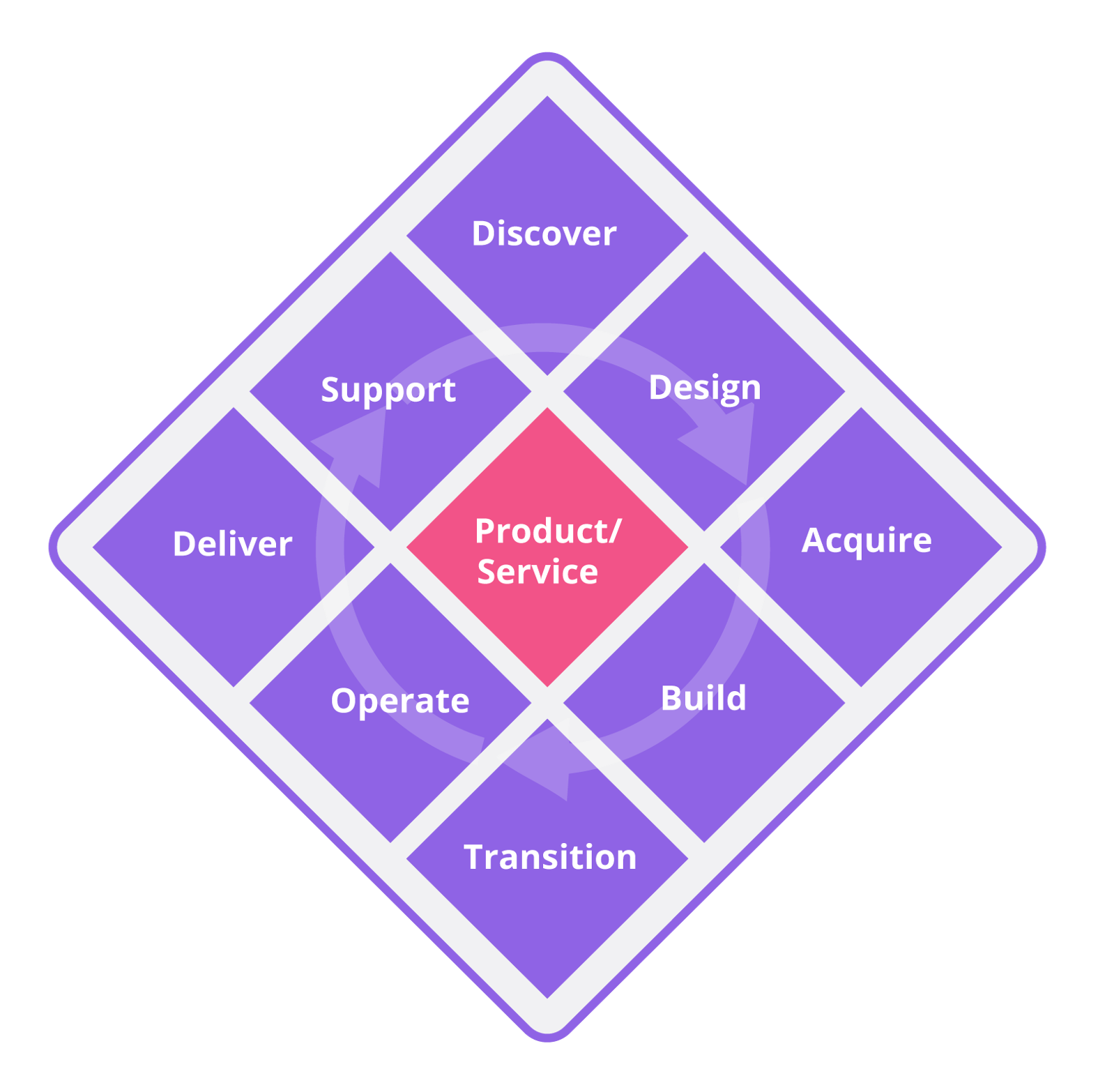
This 8-stage lifecycle—Discovery → Planning → Acquisition → Building → Transition → Operation → Procurement → Support—outlines how products and services move through a unified value delivery system.
3. Increasing Complexity and the Need for Agility
While ITIL V4 certainly emphasized agility, an AI-driven environment demands a much higher level of adaptability and experiment-based operations. ITIL V5 addresses this by serving as a complexity-native framework designed to flexibly combine and adapt processes within unpredictable environments.
Today's organizations operate in a volatile, uncertain, complex, and ambiguous (VUCA) world. Operating under this premise, ITIL V5 moves away from predictable, plan-heavy strategies, focusing instead on experimentation, learning, and continuous adaptation.
In ITIL V5, AI, automation, and digital product-centric operations are the baseline. This demonstrates that the framework prioritizes managing and leveraging complexity rather than trying to oversimplify intricate systems.
While ITIL V4 strictly defined practices, ITIL V5 applies practices and value streams more dynamically. In its complexity-native framework, the rigid adherence to fixed processes is replaced by the agility to combine and alter processes based on the situation.
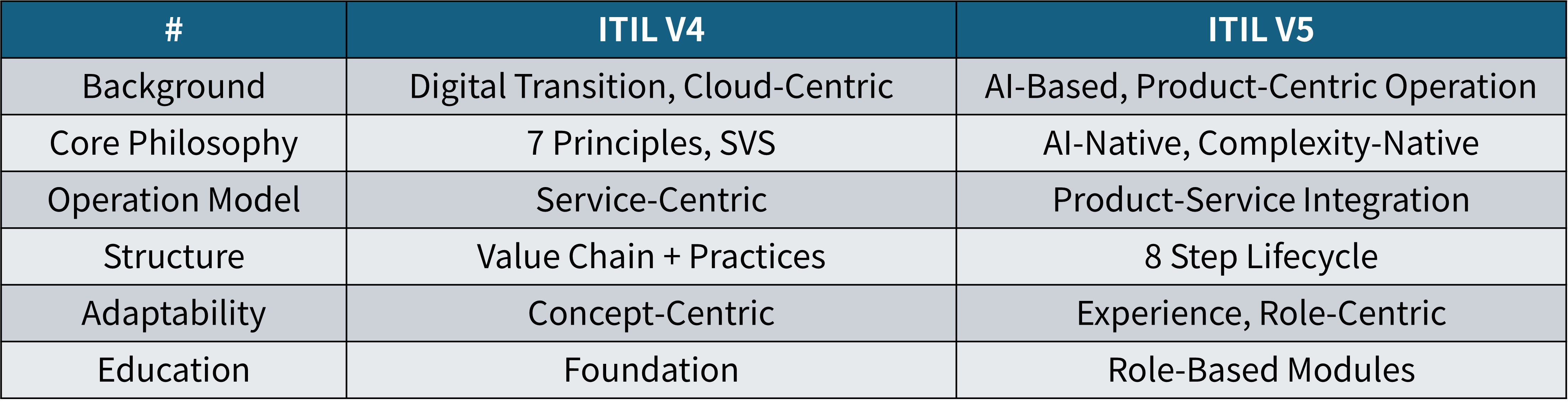
4. ITIL 4 vs. ITIL 5: Summary of Core Evolution
The evolution from ITIL V4 to ITIL V5 encapsulates these shifts, which are also reflected in the new ITIL V5 certification curriculum. The Value Chain model has been streamlined, and the previously massive catalog of 34 practices is now elegantly mapped across the new 8-stage lifecycle.
ITIL V5 directly addresses an unpredictable, AI-driven workplace and an era of unified product-service operations. It is set to become the foundation of modern ITSM, enabling organizations to navigate today's fast-paced digital landscape with greater agility.