
 Contact

Community
Conditions for Successful IT Governance and ITSM Implementation Consulting
- Date2026.07.20
When IT operations rely on the personal experience of the person in charge or department-specific practices, severe inefficiencies occur due to inconsistent incident handling standards and ambiguous roles and responsibilities (R&R) between organizations. This can go beyond simple work delays to poor incident response quality, increased risk of change failure, decreased data reliability, and internal audit risks. To prevent these problems from occurring, the transition of IT operations to a service-oriented management system that can systematically control them is necessary. Today, I will inform you of the core processes and execution strategies of ITSM, IT Governance, and ISO/IEC 20000 consulting for this purpose.
Core Purpose of Consulting: Establishing a Realistic Target Operating Model (To-Be)
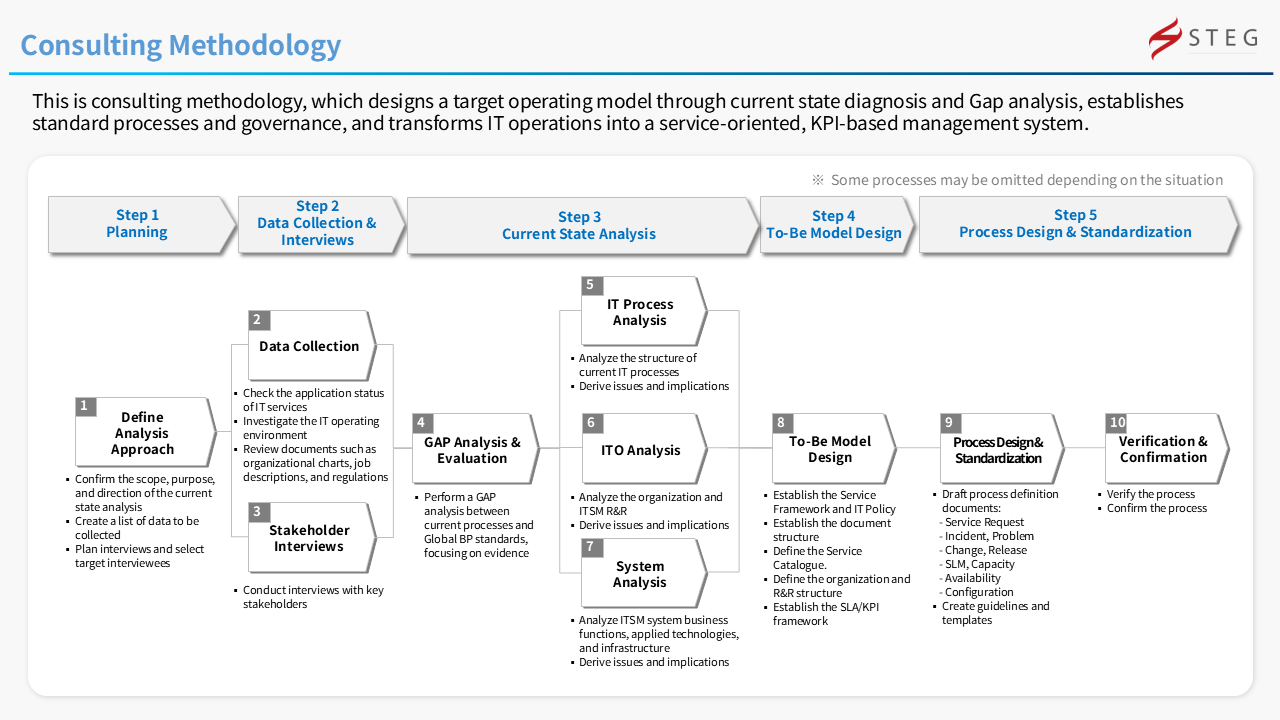
IT consulting is not simply pointing out current problems or blindly restricting operations to comply with ideal global standards (e.g., ITIL, ISO/IEC 20000). Successful consulting comprehensively analyzes the organization's size, available manpower, work characteristics, system environment, and current maturity level to design a "target operating model" that can be applied in actual practice. To achieve this, systematic steps are taken as follows.
Diagnosis and Objective Current State Identification
The first step of IT consulting is defining the purpose and scope. In this stage, the overall standards for the task are established, including target processes, governance structure, and whether to prepare for certification. Subsequently, the current state of IT operations is diagnosed by collecting objective data such as operational policy documents, incident histories, and system data. Additionally, concurrent interviews with key stakeholders are conducted to identify structural limitations that are difficult to grasp on paper, such as actual operational flows, internal organizational grievances, and approval delays.
Multidimensional Analysis and Deriving Realistic Priorities
Once the operational status diagnosis is completed, consulting conducts a multidimensional analysis of the IT operating system from three perspectives—process, organization, and system—based on the collected data.
Process Perspective: We check whether defined processes are being applied to actual work and if the linkages between processes and exception handling standards are clear.
Organizational Perspective: We analyze whether there is any overlap in roles or gaps in responsibility among internal control organizations, operational practitioners, and external partners.
System Perspective: We verify whether the implemented ITSM framework is smoothly performing workflow control and data dashboard functions, and whether non-standardized work channels are being used in parallel.
After the multidimensional analysis, a Gap analysis is conducted between global best practices like ITIL and the actual conditions of the target organization. Through this Gap analysis, consulting determines realistic implementation priorities so that areas offering the highest improvement in operational stability and control effectiveness can be addressed first.
Integrated Operating System Design (To-Be Model)
In this stage, the target operating system to be pursued is designed based on the diagnosis results. Here, it is crucial to align individual processes into an organically connected, integrated structure. For example, a design might clearly distinguish service requests from incident management, or tightly link change management with configuration and release management. In an ideal integrated operational framework, processes, organizations, systems, and key performance indicators (KPIs) work harmoniously within a single system.
Practice-Oriented Execution Standards and Documentation
To apply the designed To-Be model to actual operations, specific execution standards are required. Policy documents, regulations, guidelines, and detailed templates (request forms, checklists, etc.) that specify the application scope, workflow, approval criteria, and exception handling plans for each process must be established. The documented system secured in this way ensures work consistency and serves as evidence for future ISO/IEC 20000 certification or internal controls and audits.
On-site Verification and System Confirmation
This is the verification stage to confirm whether the finally designed standard processes and document structure operate without difficulty in the actual operational environment. At this time, stakeholders closely review the appropriateness of roles and responsibilities (R&R), the practicality of approval procedures, and the measurability of KPIs to supplement and optimize the system one last time. Once this stage is completed, the system to be used in the actual field is confirmed.
The purpose of systematic ITSM and IT governance consulting is to transition from an operating method that relies on personal empirical knowledge to a standardized process, clear responsibility structure, measurable performance, and system-based control framework. Through practical diagnosis and target model establishment, companies can advance their IT operational capabilities and lay a firm foundation for sustainable quality improvement and global certification system compliance. If you want to elevate your company's IT operations to the next level, start systematic diagnosis and target model establishment with STEG right now!
@STEG Luke Kim